Thatta's monuments include the Jama Mosque (also Shahjehani Mosque and Badshahi Mosque), built by Shah Jahan in 1647-49. The Shah Jahan Mosque is located in Thatta, Sindh province, Pakistan. It is included in the UNESCO World Heritage and has been to preserved since its entry.
 Shah Jahan Mosque Postcard
The mosque is built with red bricks with blue coloured glaze tiles probably imported from another Sindh's town of Hala.The mosque has overall 100 domes and it is world's largest mosque having such number of domes. It has been built keeping acoustics in mind. A person speaking inside one end of the dome can be heard at the other end.
SOURCE:Shah Jahan Mosque Wikipedia Entry
The Lahore Fort, locally referred to as Shahi Qila is citadel of the city of Lahore, Punjab, Pakistan. It is located in the northwestern corner of the Walled City of Lahore. In 1981, the fort was inscribed as a UNESCO World Heritage Site along with the Shalimar Gardens (Lahore).
 Lahore Fort Postcard
The trapezoidal composition is spread over 20 hectares. Origins of the fort go as far back as antiquity, however, the existing base structure was built during the reign of Mughal Emperor Akbar (1556-1605), and was regularly upgraded by subsequent rulers. Thus the fort manifests the rich traditions of the entire Mughal architecture. Some of the famous sites inside the fort include: Sheesh Mahal, Alamgiri Gate, Naulakha pavilion, and Moti Masjid.
SOURCE:Lahore Fort Wikipedia Entry
The Acropolis of Athens is the best known acropolis (high city, The "Sacred Rock") in the world. The Acropolis was formally proclaimed as the pre-eminent monument on the European Cultural Heritage list of monuments on 26 March 2007, and was added to the UNESCO's list of World Heritage Sites in 1987. The Acropolis is a flat-topped rock which rises 150 m (490 ft) above sea level in the city of Athens. It was also known as Cecropia, after the legendary serpent-man, Kekrops or Cecrops, the first Athenian king.
 Acropolis of Athens Postcard 1
The Acropolis of Athens and its monuments are universal symbols of the classical spirit and civilization and form the greatest architectural and artistic complex bequeathed by Greek Antiquity to the world. In the second half of the fifth century bc, Athens, following the victory against the Persians and the establishment of democracy, took a leading position amongst the other city-states of the ancient world. In the age that followed, as thought and art flourished, an exceptional group of artists put into effect the ambitious plans of Athenian statesman Pericles and, under the inspired guidance of the sculptor Pheidias, transformed the rocky hill into a unique monument of thought and the arts.
 Acropolis of Athens Postcard 2
Site Monuments: Parthenon, Erechtheion, Propylaea, Temple of Athena Nike, Brauronion, Temple of Rome and Augustus, Pedestal of Agrippa, Beule Gate, Acropolis fortification wall, Chalkotheke, Old temple of Athena
SOURCES:Acropolis of Athens Wikipedia Entry
UNESCO World Heritage: Acropolis, Athens
Notre-Dame de Reims (Our Lady of Rheims) is the cathedral of Reims, where the kings of France were once crowned. It replaces an older church, destroyed by a fire in 1211 that was built on the site of the basilica where Clovis was baptized by Saint Remi, bishop of Reims, in AD 496. Notre-Dame de Reims cathedral, the former Abbey of Saint-Remi, and the Palace of Tau were added to the list of UNESCO World Heritage Sites in 1991.
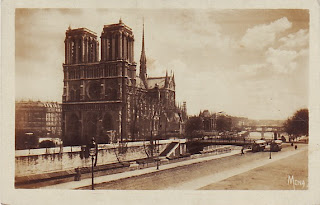 Notre Dame and the Seine View Postcard
The cathedral was completed by the end of the 13th century, with the exception of the western front. That portion was erected in the 14th century, following 13th century designs—the nave having in the meantime been lengthened to afford room for the crowds that attended the coronations.
The towers, 81 m tall (approx. 267 ft), were originally designed to rise 120 m (approx. 394 ft). The south tower holds two great bells; one of them, named “Charlotte” by Charles, Cardinal of Lorraine in 1570, weighs more than 10,000 kg (about 11 tons). The façades of the transepts are also decorated with sculptures. The inside of the cathedral is 138.75 m (about 455 ft) long, 30 m (approx. 98 feet) wide in the nave, and 38 m (about 125 feet) high in the centre.
SOURCE:Cathedral of Notre-Dame, Reims Wikipedia Entry
From the Louvre to the Eiffel Tower, from the Place de la Concorde to the Grand and Petit Palais, the evolution of Paris and its history can be seen from the River Seine. The Cathedral of Notre-Dame and the Sainte Chapelle are architectural masterpieces while Haussmann's wide squares and boulevards influenced late 19th- and 20th-century town planning the world over. The Banks of the Seine in Paris were added to the UNESCO's list of World Heritage Sites in 1991.
 The Trocadero and Eiffel Tower Postcard
The Trocadéro, site of the Palais de Chaillot, is an area of Paris, in the 16th arrondissement, across the Seine from the Eiffel Tower. For the Exposition Internationale of 1937, the old Palais du Trocadéro was demolished and replaced by the Palais de Chaillot which now tops the hill. It was designed in classicizing "moderne" style by architects Louis-Hippolyte Boileau, Jacques Carlu and Léon Azéma. Unlike the old palais, the wings are independent buildings and there is no central element to connect them: instead, a wide esplanade leaves an open view from the place du Trocadéro to the Eiffel Tower and beyond.
 Eiffel Tower Postcard
Named after its designer, engineer Gustave Eiffel, the Eiffel Tower is the tallest building in Paris and one of the most recognized structures in the world. Including the 24 m (79 ft) antenna, the structure is 325 m (1,063 ft) high (since 2000), which is equivalent to about 81 levels in a conventional building. Gustave Eiffel engraved on the tower seventy-two names of French scientists, engineers and other notable people.
SOURCES:UNESCO World Heritage: Banks of the Seine in Paris
Trocadéro Wikipedia Entry
Eiffel Tower Wikipedia Entry

 Shah Jahan Mosque Postcard


